
Uptodown is a Malaga (Spain) based app download platform that has gradually carved out a niche in the global market, positioning itself as the primary alternative to Google Play. This is the story of Uptodown, a company founded by two young computer engineers using their own savings, who managed to turn it into a multi-million-euro business without relying on external investors or tech partners.
Generally, the startup world is full of success stories driven by venture capitalists providing the capital needed to scale, or tech partners opening doors to new markets. However, instances of entrepreneurs who manage to overcome every hurdle and secure a leading position in such a competitive tech ecosystem using nothing more than their own limited savings and hard work are remarkably rare. This is precisely the case with Uptodown.
What makes their story even more exceptional is that, despite reaching a prominent market position, they have turned down multi-million-dollar buyout offers, choosing instead to remain at the helm of the daily battle against global giants. As they put it, it is not about the money, but about the thrill of remaining at the forefront of the industry.
The Birth of Uptodown
Luis Hernández and José Domínguez met while studying Computer Engineering at the University of Malaga. Like many of their peers, they spent hours building applications that ultimately stayed under the radar due to a lack of distribution channels; they could only share them with family and close friends. As a university project, they came up with the idea of creating a web service where developers could publish their software and gain exposure to potential users. The goal was to offer an open, reliable software distribution platform.
Without overthinking it, and before even graduating, they launched an app download portal called Uptodown.com in 2002. They were just 22 years old. In July 2003, they formalized the venture legally by incorporating the company Media Ingea SL. Their initial share capital consisted of nothing more than a couple of desktop computers and 20 euros in cash.
They started by building a catalog containing their own software alongside third-party applications. Months before generating any revenue, they spent their time handling editorial tasks, curating new software for the catalog, and marketing their services.

The truth is that both friends shared a deep passion for software development. José Domínguez (“Pepe”) was a specialist in P2P software and distributed messaging, while Luis had developed ambitious projects such as Eremus (an online card game) and Kas2001. The latter was an early artificial intelligence program that allowed users to interact via voice or text and automate desktop tasks, such as launching applications or checking email, essentially an early predecessor to Alexa or Siri, built for Windows.
The Business Model
Their website, uptodown.com, hosted applications uploaded by developers and provided the necessary tools for users to discover and securely download the software they were looking for. It was, and remains, what is known today as an app store.
In traditional app stores, developers set their own pricing, and the platform processes the payment from the end user. Typically, these platforms retain a revenue share commission and pay out the remainder to the author; for instance, platforms like Google or Apple historically took a 30% cut. Uptodown, however, chose a different monetization strategy. They decided not to take any commission on software sales, relying instead entirely on ad revenues generated across their download platform.
Furthermore, unlike competing download hubs, they have always abstained from aggressive ad units, forced app installs, and dark patterns. Their sole intervention regarding uploaded software is conducting thorough security checks to ensure applications are completely free of viruses and malware.
To achieve profitability under an ad-supported model, driving high user volume was essential. From day one, their core operational focus was web traffic generation. Users visiting the site interact with non-intrusive ads, which constitute the company’s sole source of revenue.
The Early Years
Thanks to a spin-off award granted by the University of Malaga, they moved into their own office space in January 2003. It was a temporary office located within the tech park, but fortunately, their hard work soon began to pay off. Web traffic steadily grew, and early revenues started trickling in. Nevertheless, during those first two years, income remained extremely modest, and they barely scraped by. On more than one occasion, they questioned whether the project had a sustainable future.
At that time, the applications shared by users were primarily desktop software, so they focused on distributing Windows applications.
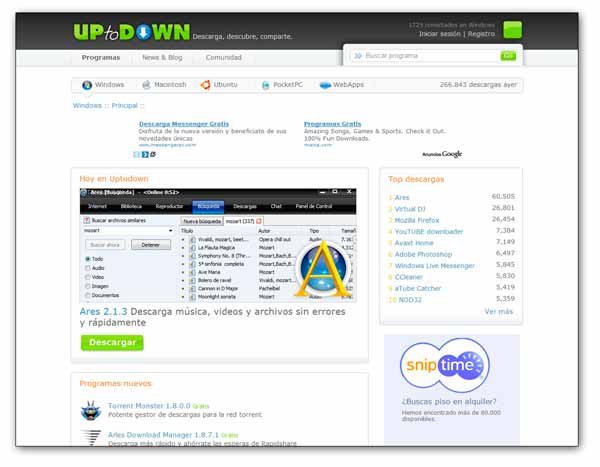
The year 2005 marked a major milestone in Uptodown’s history. Web traffic grew sufficiently for the business to finally reach profitability. In fact, in September of that year, they brought on their first employee, Álvaro Toledo Sánchez, to oversee platform content. This was a key hire, as the Windows software catalog would expand significantly over the following years, and the Uptodown community forum gained immense popularity across both Spain and Latin America.
In 2006, they prioritized SEO optimization and enhancing the site’s user experience (UX). Their visibility and reputation within the tech sector grew considerably. As a result, major corporations such as Telefónica, Axel Springer, and eBay Spain brought them on as consultants for prominent digital projects, including Páginas Amarillas (Yellow Pages) and Computer Hoy magazine.
The Internationalization of Uptodown
Following those initial years of relentless effort and modest returns, they decided to take a major leap forward: committing fully to international expansion. In June 2007, they hired web developer Daniel Rivas to restructure the platform and adapt it for multilingual operations. They began producing all content in English and, shortly thereafter, in Portuguese, with a strong focus on the Brazilian market.
The two founders formed a highly cohesive team and, over time, naturally carved out their respective leadership roles. Luis Hernández assumed responsibility for overall strategy and team management (acting as CEO), while José Domínguez focused on technical operations and architecture (acting as CTO).
In 2008, they expanded their presence across Europe, entering France, Germany, and Italy, and began making inroads into the Asian market. These strategic moves placed them firmly on the global map as a notable player within the digital distribution sector. This internationalization process accelerated until the platform achieved global reach, offering its services in 15 languages with dedicated local teams backing each region (two to three specialists per language).
The Shift to Smartphones
The first decade of the 2000s marked the emergence of smartphones. BlackBerry (2002) and Palm (2003) devices led the early wave of mobile handsets capable of handling email and managing calendars. In 2007, the launch of the first iPhone, featuring a touchscreen interface and an intuitive operating system, signaled the start of a new tech race that continues to evolve today. Shortly after, in 2008, the first smartphone powered by the Android operating system hit the market.
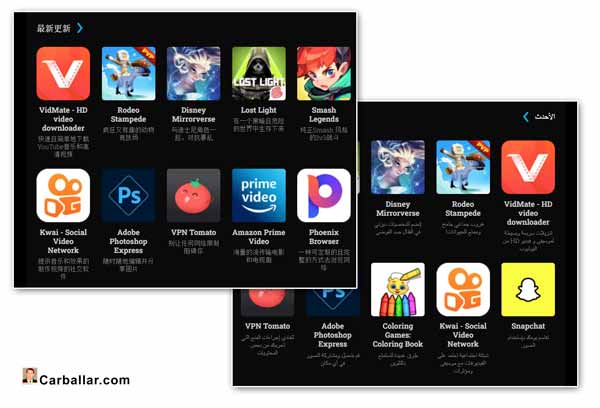
Against this backdrop, Uptodown decided to make a major strategic shift toward smartphone applications in 2011. They went all-in on Android apps, positioning themselves as a direct alternative to Google. They launched their mobile offering with 2,500 Android applications spanning major categories, from entertainment and productivity to travel and multimedia.
This strategic move proved to be a major turning point for Uptodown, sparking exponential traffic growth and attracting millions of monthly active users.
These milestones solidified the company’s status as a globally recognized mobile app store. While they initially offered mobile downloads exclusively through their web platform, they took another major step forward in 2014 by developing their own native Android App Store. With this launch, they formally established themselves as a direct competitor and alternative to Google Play.
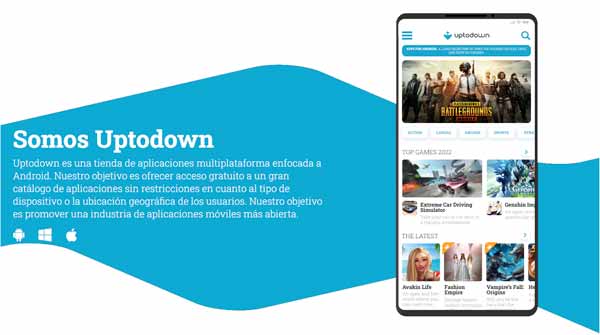
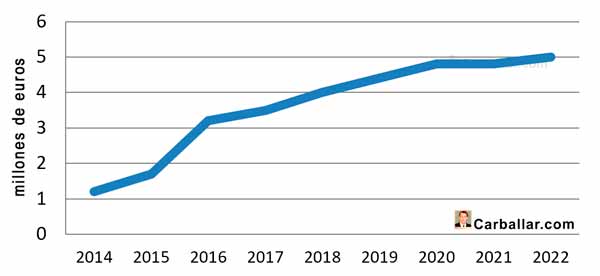
By late 2014, Uptodown reached 25 million monthly visits and 130 million annual downloads, generating over one million euros in revenue. Their workforce grew to 10 employees at headquarters alongside 30 remote team members. That same year, they localized their platform into Arabic, Russian, Japanese, Korean, Chinese, and Indonesian, bringing their total supported languages to 12. This multilingual footprint enabled them to reach potentially 90% of global internet users, an international coverage level achieved by very few companies worldwide.
Uptodown as a Google Competitor
In 2015, Uptodown launched LaunchPad in the United States. It was a marketing platform designed to help developers test and scale mobile applications during early-stage development, as well as boost global visibility for existing software. Shortly after, the company partnered with the prestigious MIT (Massachusetts Institute of Technology), enabling students to publish their apps on the Uptodown platform. This partnership granted them exclusive access to software not available on other channels, ultimately driving their US monthly traffic beyond three million unique visitors.
This momentum heightened their industry profile, leading media outlets to consistently ask Luis Hernández whether their goal was to replace Google Play. However, Hernández remained realistic, often pointing out that their market share represented about 1% of Google’s footprint.
In reality, Hernández viewed Uptodown less as a direct rival and more as a complementary player within the Android ecosystem. Downloading an app through Google Play requires user registration and a pre-installed store client. Uptodown, by contrast, operates on a frictionless model: users can search for and install applications directly via their web browser without creating an account, linking payment methods, or installing third-party software. In Hernández’s words, “Uptodown helps expand the broader Android ecosystem“, which ultimately aligns with Google’s underlying strategy.
Despite this initial positioning, the strategic divergence between the two platforms widened over time. Uptodown increasingly aligned with industry voices that view Google as a de facto monopoly abusing its market dominance to suppress competing software and developers. Hernández highlights that while Google Play’s rankings are dominated by tech giants like WhatsApp, YouTube, Facebook, and Spotify, Uptodown hosts both mainstream applications and alternative software that Google restricts. As a result, Uptodown’s software catalog expanded to roughly four times the size of Google Play’s.
These operational differences are reflected in their respective top download charts. While Google Play is led by ubiquitous applications like WhatsApp or Spotify, Uptodown’s top-downloaded app has historically been TubeMate, a YouTube video downloader banned from Google Play.
According to its founders, Uptodown adheres to an unbiased, decentralized distribution philosophy, refraining from removing applications due to commercial conflict or strategic interests. Furthermore, they archive legacy versions of all listed software, allowing users with older hardware to maintain functionality.
Another key differentiator highlighted by Hernández is Uptodown’s reliance on human editorial teams. Unlike Google Play, dedicated specialists manually test, review, and evaluate every application. By 2016, Uptodown had published over 40,000 editorial reviews.
While Google relies strictly on developer-provided descriptions and user reviews, Uptodown maintains that independent, expert-curated editorial content provides users with objective and valuable insight.
Hernández summarized their position succinctly: “We offer the ability to download any version of any content from any country, free from the geographic or political restrictions imposed by Google Play“. To bypass these ecosystem constraints, they continue to prioritize the open web as their primary distribution channel.
Years of Growth
After years of sustained effort, by 2016 Uptodown operated in 15 languages with a presence spanning virtually the entire globe. They generated €3.2 million in ad revenue, a 90% increase year-over-year, and delivered over 200 million monthly downloads. Behind Google, albeit with a significant gap, they had solidified their standing as the leading distribution channel for Android software.
Remarkably, they achieved these metrics with a lean core team of just 10 full-time employees, supplemented by external localization specialists. They leveraged technology intelligently to automate routine workflows, maintaining the agility and efficiency of a high-growth startup.
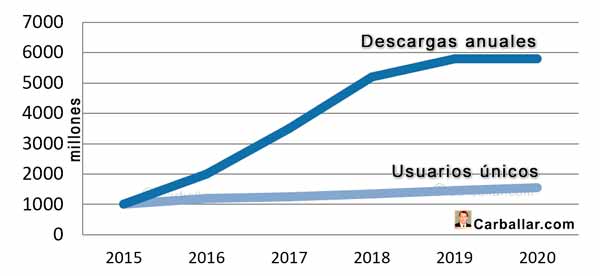
The year 2017 marked another major milestone in Uptodown’s history. The platform broke into the Alexa top 100 most visited websites globally. By August of that year, it recorded 107 million monthly unique visitors and 499 million page views. In several key markets, its local web traffic rankings were even more pronounced: reaching #21 in Brazil, #19 in Mexico, and #9 in Morocco. In Spain, it emerged as the highest traffic-generating domain nationwide.
To put this traffic volume into perspective, in 2017 Uptodown processed more global web traffic than major platforms such as Spotify (ranked #165 on Alexa), TripAdvisor (#246), or Airbnb (#299).
When they originally incorporated the business in 2002, they named the legal entity Media Ingea SL. To align their corporate structure with the global brand they had built, they officially rebranded the company to Uptodown Technologies SL in July 2017. By the end of that year, the central headquarters in Malaga employed 12 team members, supported by two to three localization managers per region globally.
In 2018, the platform reached 485 million monthly downloads and surpassed €4 million in annual turnover. Revenue, multi-billion annual download metrics, and headcount continued on an upward trajectory year after year. During this era, Uptodown’s growth trajectory was defined by consistent, sustained scaling.
Becoming an Official App Store
Despite their strong market position during those years, the path forward for sustained growth was not entirely clear. Given the immense friction involved in competing against the developer and owner of the operating system itself, their strategy pivoted toward distributing applications for alternative hardware: smart TVs, automotive systems, and other connected devices. In fact, they set a goal to secure OEM distribution deals to have their App Store pre-installed directly into device ROMs.
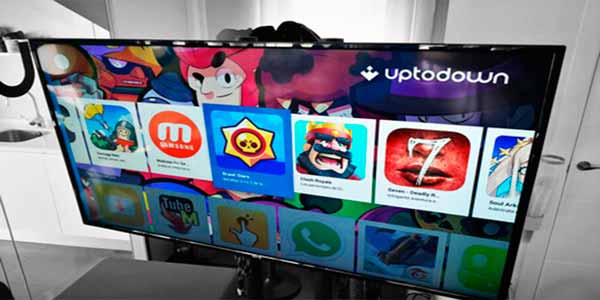
After extensive business development efforts, in 2019 they successfully integrated the official Uptodown app as the default app store across various hardware platforms and devices. These included NPG Smart TVs, media hubs like Entertainment Box, the Puppy Cube projector, and Android emulation and virtualization platforms such as LDPlayer and NOX App Player.
Building on these milestones, global gaming platform Unity reached out in 2020 to distribute their titles via Uptodown. Unity is the global leader in game development engines. Commenting on the strategic partnership, Luis Hernández noted, “It’s huge for us; it truly puts us on the map“.
Up to that point, their business model relied exclusively on ad monetization. The Unity partnership unlocked a new revenue stream by introducing a commission-based revenue share model: Uptodown would retain a 20% take rate, passing the remaining 80% to developers. For creators, this offered a far more competitive yield compared to the standard 30/70 revenue split maintained by Google and Apple. Increased competition in the space will likely pressure incumbents to improve their terms.
As Hernández explained following the agreement, software developers distribute their titles across multiple platforms (Xbox, PlayStation, iOS, Android, Windows, Ubuntu, etc.), and Unity stands as one of the major distribution engines, dominating the mobile gaming sector.
Acquisition Attempts and Buyout Offers
Luis Hernández and José Domínguez founded the company relying entirely on their personal savings. Within six months of launching, the business achieved profitability, and they have managed its expansion ever since without taking on external capital. However, this bootstrapped approach did not insulate them from economic downturns, periods during which they had to reduce headcount, forego their own salaries, and tap back into their personal savings. Looking back, the founders admitted that their youth worked to their advantage: “Launching a company as a student is fundamentally different from doing so at 40. You have less to lose, and in a way, you benefit from a degree of recklessness“.
Regardless, while their profit margins remained lean, their underlying operational metrics, traffic volume, unique monthly visitors, and download totals, were consistently extraordinary. Unsurprisingly, this level of traction attracted significant interest from potential acquirers.
As the founders revealed in various interviews, they have received multiple buyout proposals over the years, though none provided a compelling enough fit. In 2015, a German media group extended a €6 million purchase offer, followed by a €13 million bid from Grupo Planeta. They turned down both opportunities, citing “too much fine print” in the deal terms.
More recently, they rejected acquisition offers exceeding €100 million. Explaining their rationale, Luis Hernández noted: “Pepe and I want to retain full operational control rather than surrendering it to another corporation. And if the capital doesn’t directly enhance the product, the deal makes no sense“.
Both co-founders emphasize that their decision-making is not driven by valuation, but rather by finding a partner that aligns with their strategic roadmap. As they put it: “We would only consider a sale as a strategic maneuver, never a purely financial exit. Would we sell the company to Google for a massive payout? Never. Would we partner with or sell to Yahoo to challenge Google? That is a completely different conversation“.
By 2022, Uptodown employed 35 core team members at its headquarters, backed by an additional 50 remote specialists worldwide. Annual revenue reached €5 million, while traffic and download figures continued their upward trajectory. Whether they will soon connect with the right partner, one providing the strategic leverage and financial backing needed to cement their position as a formidable competitor to Google, remains to be seen.
Conclusions
What makes this story particularly striking is that the company never conducted market research, never drafted a formal business plan, and never built dedicated sales or marketing teams. Instead, its founders relied almost entirely on intuition to guide their strategic decisions.
During the 2015 Hackers Week event hosted by the University of Malaga, the two co-founders shared their five golden rules for launching a startup with the attending students. These principles stand out for their unorthodox nature, offering a raw reflection of the real-world experience of two successful entrepreneurs.

The five golden rules are:
- Do not waste time or effort on a business plan. According to the founders, nobody actually reads a business plan, and it becomes obsolete almost immediately. It is better to focus execution on building the product itself. (It is worth noting this perspective comes from a team that bootstrapped their growth and never required external venture capital).
- Choose your team carefully. Finding people who align with your vision and understand the project is critical. In the early days, everyone wears multiple hats, making team cohesion and alignment vital.
- Be ambitious. Luis Hernández argued that founders must set bold, long-term goals rather than settling for short-term targets. Pursuing an ambitious vision is what inspires people to follow you.
- If you are not having fun, quit. Entrepreneurship is an endless obstacle course. Having passion and enjoying the day-to-day work is what fuels the drive to overcome these challenges. You have to enjoy the journey.
- Find an evangelist. Hernández pointed out that when you start out, you are on your own, lacking critical mass and guidance. Having a mentor or reference figure who acts as a knowledge platform can help keep you on the right path.
According to Luis Hernández, keeping their headquarters in Spain has proven to be a major advantage. Developers globally view Europe as a more neutral space compared to the United States, allowing Uptodown to connect seamlessly with partners across both Eastern and Western markets.
Admittedly, the title of this article may sound somewhat bold. Uptodown is a lean company with a small team and modest overall revenue. However, its monthly active user metrics, download volumes, and global market presence are genuinely extraordinary. While these business figures represent roughly 2% of Google Play’s footprint, Uptodown stands today as Google’s largest direct competitor in the space, a milestone achieved by a small team relying entirely on their own bootstrapped resources. No matter how you look at it, this remains a compelling success story.
Further Information
This article has summarized the Uptodown Story, the Google Play alternative. If you are seeking inspiration or are interested in these topics, this blog features a wide array of related content. Entrepreneurship is a fascinating journey that generates countless inspiring stories. If you are looking for motivation or simply interested in business ecosystems, this blog features a wealth of related content. Feel free to use the search bar in the header to explore more articles.
Additionally, here are a few other articles that may be of interest: