

Over recent years, we have witnessed extraordinary breakthroughs in artificial intelligence solutions designed to handle language, images, and voice. However, most of the information holding a company’s true economic value resides neither in text nor in photos, but in something far more mundane: data tables. We are talking about spreadsheets, databases, customer records, sales histories, operations, and credit risks. All this information typically lives in data tables, organized in rows and columns, that underpin the daily decisions of any organization. Gaining a deep understanding of how this data behaves would yield a massive advantage for any enterprise. That is precisely what AI models known as TFMs (Tabular Foundation Models) aim to achieve: they represent the next revolution in enterprise AI.
TFMs, or Tabular Foundation Models, are a new breed of artificial intelligence designed not to master natural language, but to master structured data organized in tables. Language models such as ChatGPT or Gemini are known as LLMs (Large Language Models) because they are trained on massive volumes of natural language text. By contrast, TFM models are not trained on text, but on structured data from tables. They leverage vast collections of heterogeneous tables to learn general patterns that can later be used to predict outcomes across a wide variety of business challenges.
Until now, when a business needed to predict credit defaults, for instance, it relied on a machine learning technology designed for specific applications. These are relatively simple tools whose main value comes from being trained explicitly to tackle one specific problem. If the company also needed to estimate demand, detect fraud, or compute supplier risk, it had to train and build a separate solution for every single task. This meant repeating an entire workflow over and over again: data preparation, algorithm selection (XGBoost, LightGBM, Random Forests, etc.), feature engineering, hyperparameter tuning, validation, and deployment. It is a process that consumes vast amounts of time and high-value talent.
TFM models are far more complex. Like LLMs, they undergo a highly sophisticated general pre-training phase, but they offer the tremendous advantage of functioning as a general-purpose predictive engine capable of addressing multiple tasks. Models such as TabPFN or TabFM have proven that this concept is not merely elegant in theory, but remarkably effective in practice. In many scenarios involving small to medium-sized datasets, these models equal or surpass traditional machine learning methods, without requiring custom training for each table. Simply passing the dataset rows to the model within a single context is enough to generate predictions in a single pass.
Below, we will explore the fundamentals of TFM models: what they are, how they differ from LLMs, how they deliver value in practice, how they apply to real-world business data, and what specific alternatives exist today in both commercial markets and the open-source ecosystem. The goal is to provide a clear, actionable vision for executives, chief data officers, and professionals looking to understand why TFMs may well be the missing piece in enterprise AI.

How Enterprise Structured Data Is Analyzed Today
Most of the data critical for corporate decision-making resides in structured formats, namely databases and spreadsheets organized in rows and columns. Over the past two decades, the dominant approach to analyzing this data has relied on traditional machine learning tools.
Machine learning is a subset of artificial intelligence that excels at solving very specific tasks through targeted training. It is exceptionally effective at driving data-driven decisions, making it an indispensable asset for modern enterprises.
Today, companies employ a wide variety of enterprise machine learning software, including LightGBM, CatBoost, and XGBoost. These are general-purpose software frameworks based on statistical models that must be explicitly trained to solve each specific problem. Furthermore, this supervised training requires human oversight from expert data professionals throughout key phases of the process.
Training takes place by feeding the system vast amounts of historical data and known outcomes. The more data provided during this phase, the more accurate and sophisticated the predictions become. Simply put, machine learning is learning by example. Once trained, the software leverages these learned patterns to forecast outcomes or automate decisions.
The main drawback of these traditional tools is their need to be retrained from scratch for every single business problem, whether predicting payment defaults, forecasting demand, detecting fraud, or calculating customer churn risk. The typical workflow involves extracting data from internal enterprise systems (ERP, CRM, operational databases), cleaning it, selecting key variables, choosing the appropriate algorithm for the data structure and problem type, training the system, validating its performance, and deploying it into production. This requires significant time, budget, and specialized technical talent.
Traditional machine learning solutions rely on underlying statistical models, and no single statistical algorithm performs best across all types of data. As a result, enterprises end up deploying a disparate ecosystem of algorithms designed for different types of predictive tasks.
In the corporate landscape, the following algorithms have become the de facto standards across many organizations:
- LightGBM: A gradient boosting model based on decision trees, engineered for speed and efficiency when handling large volumes of data. Boosting means the model is iteratively trained to correct the errors of previous iterations, while gradient boosting uses the error gradient to guide each sequential model, maximizing precision and computational efficiency. LightGBM is particularly popular where high accuracy and fast training times are critical, such as credit scoring, demand forecasting, and risk modeling.
- CatBoost: Another boosting algorithm, specifically engineered to handle categorical (non-numeric) variables with high efficiency without requiring complex pre-encoding. It is widely used in industries where data tables contain extensive non-numeric columns, such as customer tiers, product codes, or contract types, and where predictive quality is paramount.
- XGBoost: A pioneer of modern gradient boosting that enjoys broad adoption across data science teams and enterprise projects. Although newer models have outperformed it in computational speed, XGBoost remains a benchmark across advanced analytics teams.
Alongside these core algorithms, businesses also deploy simpler mathematical models (such as logistic regressions, random forests, or basic neural networks) in tandem with Business Intelligence (BI) platforms like Power BI, Tableau, or Qlik. While BI tools are not AI models per se, they enable teams to visualize, explore, and segment structured data, providing a descriptive analytical layer to guide management decisions.

In recent years, Automated Machine Learning (AutoML) has gained significant ground. AutoML platforms automate key stages of the workflow: trying multiple algorithms, tuning hyperparameters, and selecting the optimal model for a specific dataset. This has enabled less specialized business users to build predictive models without diving into the underlying technical nuances of each algorithm.
However, all these approaches share a fundamental limitation: every new problem demands its own custom model. For every new business question, which accounts will default, which customers will churn, which supplier might fail, or how much inventory will sell next month, teams must repeat the entire pipeline: data preparation, algorithm selection, training, validation, and deployment. It is a powerful paradigm, but one that is highly demanding in time, talent, and ongoing maintenance. Models decay over time, data distributions drift, relationships break, and every new use case adds another piece of technical debt to the organization’s infrastructure.
This is precisely the landscape where Tabular Foundation Models enter the picture: not to immediately replace LightGBM, CatBoost, or XGBoost, but to offer a faster, simpler, and far more scalable alternative when businesses need results without multiplying their model management overhead.
What is a TFM Model?
Traditional machine learning solutions require explicit human intervention during their development and training cycles. However, the advent of advanced neural network architectures enabled a different paradigm known as deep learning. Its primary advantage lies in its capacity for fully automated feature learning during training. Furthermore, while classic machine learning models require meticulously structured input data, deep learning networks can ingest raw, unstructured data directly.
Deep learning networks are far more complex and demand significantly more powerful hardware (such as GPUs or TPUs). Large Language Models (LLMs), such as ChatGPT or Gemini, are deep learning architectures built upon complex neural networks. Multimodal models for audio, image, or video generation also rely on these deep learning foundations.
When we refer to tabular data, we mean information structured in tables, that is, arranged in rows and columns. This is the standard format found in spreadsheets (such as Excel), relational databases (SQL), accounting and sales software, and core enterprise management platforms like ERPs, CRMs, or Business Intelligence suites. Tabular data encompasses not only numerical values (prices, revenues, web traffic, etc.), but also categorical data (country, color, customer segment), ordinal data (sizes S/M/L, low/medium/high satisfaction tiers), temporal data (purchase dates, timestamps), and boolean flags (yes/no, true/false). The primary data generated by an enterprise, and upon which its operational decisions rely, is structured precisely this way.
The core insight behind TFMs is straightforward: if deep learning models trained on vast amounts of text (LLMs) can learn to write, summarize, and reason, why not build a similar model trained on structured tabular data? An AI model powered by neural networks and pre-trained on tabular datasets is precisely what we call a TFM (Tabular Foundation Model).
A TFM learns to classify, forecast, estimate risks, or detect anomalies by being exposed during its pre-training phase to a massive volume and diversity of tabular data structures. The result is a single, unified model capable of handling varied data types. It serves as a general-purpose model for tabular data, capable of solving multiple downstream tasks without requiring dedicated re-training for every distinct problem. When the model encounters an enterprise dataset it has never seen before, it identifies structural patterns, correlations, and distributions similar to those encountered during its broad pre-training, rapidly delivering accurate predictions.
From an operational and strategic standpoint, this capability is precisely what makes Tabular Foundation Models such a powerful paradigm for the next generation of enterprise data analytics.
Differences Between TFMs and LLMs
Both Large Language Models (LLMs) and Tabular Foundation Models (TFMs) are large-scale AI architectures trained on massive datasets. Both are general-purpose systems capable of executing a wide array of downstream tasks, acting as a knowledge infrastructure to solve specific business problems without building models from scratch. This is precisely why both fall under the umbrella of Foundation Models, foundational systems designed to serve as the baseline for specialized AI applications.
However, TFMs and LLMs represent two distinct paradigms in artificial intelligence. LLMs (such as ChatGPT, Claude, or Gemini) are trained on vast bodies of text. Their primary objective is to master language patterns: how sentences are constructed, how ideas connect, and how to summarize or argue a point. They are built to generate coherent narrative text, emulate approximate reasoning, and interact naturally with human users. Their core strength lies in expression, interpretation, and communication.
TFMs, on the other hand, are trained on structured data tables. Rather than generating text, their mission is to predict values, classify records, estimate operational risks, or flag anomalies. Their domain is not the realm of syntax, but of columns, statistical distributions, correlations, and numerical relationships. Where an LLM learns to complete a sentence, a TFM learns to complete a row or infer a missing variable based on contextual signals provided across other columns.
While an LLM can explain a complex business strategy, draft a report, or answer open-ended questions, feeding it a raw dataset to accurately predict a target variable yields limited results. Natural language is not an optimal medium for mathematical reasoning over structured data structures. A TFM, by contrast, is optimized for these computational challenges. It does not require tables to be converted into text or described in prose; it ingests and interprets tabular data natively.
Ultimately, LLMs and TFMs do not compete, they complement each other. One interprets the enterprise world through human language; the other interprets it through structured metrics. In fact, emerging enterprise architectures increasingly combine LLMs with TFMs: the LLM functions as an intuitive conversational interface, while the TFM powers the underlying predictive engine. Together, they enable AI systems that not only converse, but accurately predict, evaluate, and decide.
Technical Foundations of TFMs
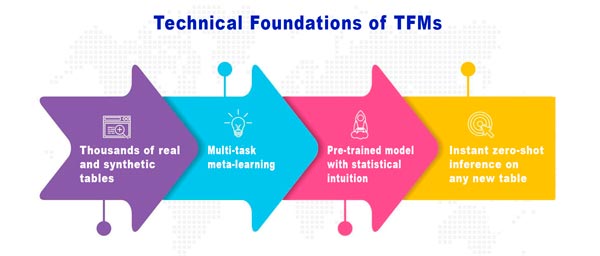
TFMs are not traditional statistical models like LightGBM or CatBoost, but deep neural networks based on the Transformer architecture, capable of learning complex data representations and scaling effectively with massive volumes of information. At their core, TFMs undergo an extensive deep pre-training process across millions of real and synthetic tables designed to address a wide variety of tasks.
Each of these tasks may involve classification, regression, missing value imputation, or anomaly detection. As the model trains, it observes how data distributions shift, how features interact, and how values behave across highly diverse contexts. Over time, it develops a form of generalized “statistical intuition” that enables it to adapt to entirely new tables without requiring additional fine-tuning or re-training.
The Transformer architecture, introduced by Google researchers in the landmark 2017 paper “Attention Is All You Need” (Vaswani et al.), marked a historic turning point in the development of LLMs and, more recently, TFMs. Fundamentally, it means that during processing, the model does not ingest data mechanically as raw inputs. Instead, it applies a mechanism known as self-attention to dynamically identify which numerical values and attributes are most critical to solving a specific task. For instance, when forecasting product demand, the model automatically learns to place greater weight on historical sales, promotional campaigns, seasonality, weather conditions, and day-of-week patterns.
The output of this mathematical transformation is represented via high-dimensional vector representations known as embeddings. These embeddings capture rich contextual metadata, allowing the system to establish fluid, non-linear relationships between variables. Consequently, individual tabular entries cease to be isolated data points; they become contextualized features. The TFM natively grasps the underlying structural dynamics of any dataset presented to it without manual feature engineering.
As one might expect, the pre-training pipeline for TFMs is comprehensive and multi-domain. The model identifies universal structural patterns across data tables in much the same way an LLM learns the underlying rules of human language. Therefore, when fed a new, unseen table, it does not need to be retrained from scratch; it simply applies its pre-learned representations to generate accurate predictions.
Another core pillar of this paradigm is prior-fitting and task simulation during training. The network is systematically exposed to thousands of synthetic scenarios: tables with few rows, datasets with high-dimensional columns, skewed distributions, collinear features, noisy entries, and missing values. In each case, it solves automatically generated prediction tasks. This exposure teaches the model to generalize effectively, build resilience against noise, and adapt to the messiness of real-world enterprise data, which is rarely pristine.
Finally, TFMs incorporate specialized mechanisms to perform effectively on small datasets, a persistent bottleneck for classic machine learning algorithms. While traditional models like XGBoost or LightGBM often overfit or degrade when training rows are scarce, TFMs leverage their pre-trained priors to compensate for limited data. This makes them particularly valuable in industries where enterprise data is fragmented, highly non-standardized, or scarce.
Taken together, Tabular Foundation Models establish a new paradigm in enterprise AI: models that learn directly from the inherent structure of data. This capability opens the door to a far more agile, scalable, and accessible way of deploying artificial intelligence across business operations.
Practical Applications of TFMs
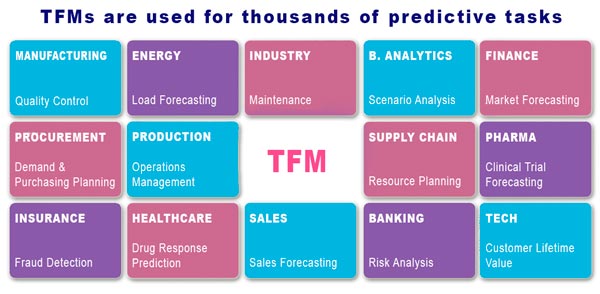
The widespread interest surrounding Tabular Foundation Models in the corporate world stems from a simple reality: beyond their technical elegance, they solve real-world operational problems with unprecedented efficiency. TFMs are not a theoretical concept; they are production-ready predictive engines capable of operating directly on an organization’s existing data tables.
One of the most common use cases is predicting payment defaults and delays. In sectors such as energy, logistics, or professional services, anticipating which clients are likely to miss payment deadlines is critical for managing cash flow and mitigating credit risk. With a TFM, a company simply feeds the model a table containing billing histories, client profiles, past transaction behaviors, and other relevant variables. Without any custom retraining, the model analyzes the inter-column relationships and outputs an instant probability of default, even when working with small or non-standardized datasets.
Another classic application is customer churn prediction. Telecommunications providers, banks, insurers, and subscription-based digital services rely heavily on their ability to flag users at risk of leaving. While traditional machine learning requires weeks of supervised training and feature engineering to build a churn model, TFMs streamline the workflow drastically. By receiving a table detailing customer usage patterns, support tickets, account tenure, and interaction histories, the TFM generates an immediate risk score. This allows companies to execute targeted retention campaigns faster and far more cost-effectively.
TFMs are equally powerful in supplier risk assessment. Across complex supply chains, identifying early warning signs of vendor failure is essential to maintaining operational resilience. A TFM can ingest tables combining historical delivery metrics, quality scores, lead times, incident reports, and contract terms to estimate the likelihood of future supplier defaults. This foresight enables executives to make proactive strategic choices, such as diversifying procurement, renegotiating contract terms, or rebalancing safety stock.
Finally, one of the most pervasive business challenges is demand forecasting. From retail supermarket chains to industrial manufacturers, every enterprise needs to estimate sales volumes over upcoming weeks or months. TFMs can process tables combining historical sales, seasonality metrics, pricing tiers, promotional calendars, and external economic signals. While they do not completely replace specialized time-series models in hyper-complex environments, they offer a fast, reliable alternative when agile predictions are required without building a dedicated model pipeline from scratch.
Across all these use cases, the pattern remains identical: the TFM ingests a table, interprets its internal relationships, and generates predictions without additional training. This dramatically slashes time-to-deployment and democratizes access to predictive AI for structured data. Workflows that previously demanded weeks of specialized engineering can now be executed in minutes, a speed advantage that, in a competitive business environment, can prove decisive.
Competitive Advantages of TFMs
The emergence of Tabular Foundation Models is not merely a technical breakthrough; it represents a fundamental shift in how organizations deploy artificial intelligence across their structured data assets.
The first advantage, and perhaps the most transformative, is the elimination of task-specific training. Under the traditional machine learning paradigm, every new business challenge demands building a custom model from scratch (data curation, algorithm selection, hyperparameter tuning, model validation). With a TFM, that entire lifecycle collapses into a single streamlined step: providing the dataset and defining the prediction task. This drastically accelerates deployment timelines and enables non-specialized operational teams to embed advanced predictive analytics into their everyday workflows.
The second core advantage is the ability to perform effectively on small datasets, a ubiquitous reality across corporate environments. While classic machine learning algorithms typically require large volumes of data to achieve high precision, TFMs leverage pre-trained priors learned from thousands of diverse tables. This allows them to extrapolate underlying structural patterns even when available data is limited, making TFMs exceptionally valuable for industries dealing with fragmented, incomplete, or hard-to-collect datasets.
Another key benefit is the reduction in operational complexity. Traditional supervised machine learning relies on specialized technical talent capable of ingesting, transforming, feature-engineering, and validating datasets to train dedicated models. Because TFMs require no task-specific retraining, they integrate seamlessly into existing IT architectures with significantly reduced friction. This democratizes AI access across the enterprise, enabling business units like finance, operations, marketing, and procurement to leverage predictive capabilities without requiring massive capital expenditure on niche technical talent.
TFMs also stand out for their inference speed. Models like TabPFN can generate predictions in a matter of milliseconds, bypassing the time-consuming training loops inherent to classical pipelines. This near-instantaneous execution unlocks real-time operational applications: instant customer segmentation, dynamic credit risk scoring, immediate anomaly detection across operational pipelines, and agile demand forecasting to guide fast-paced commercial decisions.
Finally, TFMs deliver a profound strategic advantage: centralized scalable architecture. Instead of maintaining a sprawling ecosystem of dozens of isolated, single-use models, organizations can centralize their tabular AI capabilities around a single foundational architecture. Furthermore, eliminating custom training requirements allows enterprises to rapidly expand the number of operational use cases powered by AI. This enables organizations to scale data-driven decision-making without compounding maintenance costs, simplifying data governance and establishing a cohesive, future-proof AI architecture.
Taken together, these advantages highlight why Tabular Foundation Models are rapidly becoming a cornerstone of enterprise AI strategies. They do not simply improve technical accuracy; they fundamentally transform how businesses adopt, integrate, and scale artificial intelligence across their core operational workflows.
Existing TFM Models
Although Tabular Foundation Models represent a relatively recent category within the AI landscape, the current ecosystem already offers several robust alternatives across both academic research and commercial applications. While each brings distinct architectural nuances, performance benchmarks, and focal points, they all share a common ambition: solving diverse downstream tasks without task-specific retraining.
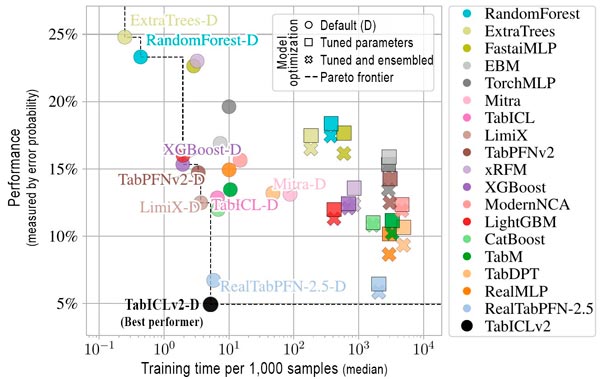
In 2022, the indisputable pioneer of TFM models emerged: the celebrated TabPFN. It was the first model built specifically for tabular data, proving that a pre-trained foundation architecture could be deployed out-of-the-box without custom fine-tuning while outperforming classical machine learning pipelines. Today, TabPFN is widely regarded as the de facto standard in the category.
TabPFN was developed by a team of researchers led by Noah Hollmann, alongside Samuel Müller, Katharina Eggensperger, and Frank Hutter, all affiliated with the University of Freiburg in Germany. Its availability as an open-source project has driven broad adoption and inspired numerous variants and extensions across the AI community.
For organizations looking to test its capabilities, TabPFN is an open-source solution that can be downloaded, installed, and executed locally or hosted on cloud servers. Enterprise development teams can seamlessly integrate it into internal ERP or CRM architectures to power predictive workflows.
In 2024, the German firm Prior Labs built upon TabPFN to release an enterprise-grade platform known as PriorTab (Prior Labs TabPFN). This model took TabPFN’s core technical foundation and optimized it for enterprise environments, delivering higher stability, commercial support, seamless data-pipeline integration, and advanced deployment capabilities. PriorTab provided businesses with a production-ready solution. In 2026, German software multinational SAP announced the acquisition of Prior Labs for over one billion euros.
PriorTab can be deployed as a Software-as-a-Service (SaaS) platform or embedded directly into internal corporate software ecosystems, including ERP, CRM, or Business Intelligence platforms.
Another notable development is RTFM (Reinforced Tabular Foundation Model). This architecture incorporates reinforcement learning techniques to enhance the model’s ability to adapt to shifting data distributions. Its approach ensures that the model not only performs effectively across diverse data types, but also learns to make optimal decisions in environments where data drifts over time. RTFM is an open-source project published by the MLFoundations organization on GitHub, making it freely available to download, deploy, customize, and build upon.
At the intersection of natural language and structured tables lies TabLLM, a hybrid model that combines the capabilities of LLMs with reasoning over structured data tables. Its goal is to enable multimodal tasks: interpreting natural language prompts, analyzing tables, and delivering predictions or explanations in plain prose. While not a pure TFM, its hybrid approach makes it a compelling asset for workflows where human-in-the-loop interaction is vital. TabLLM was developed through a collaboration between MIT (USA) and the Ludwig Maximilian University of Munich (Germany). It is open-source and accessible via its GitHub repository, with a public web demo available at tablellm.github.io.
Finally, several architectures, while not explicitly categorized as full foundation models, have heavily influenced the field. Models such as FT-Transformer and SAINT (Self-Attention and Intersample Transformer) adapted Transformer architectures specifically to tabular data. Although they are not general-purpose pre-trained foundation models, they demonstrated that Transformer-based neural networks could outperform traditional gradient boosting techniques across many tabular benchmarks. Their conceptual impact was instrumental in inspiring the broader movement toward pre-training foundation models on structured data.
The current ecosystem thus combines pioneering open-source efforts, enterprise-grade platforms, and hybrid models expanding the boundaries of the field. While TabPFN remains the benchmark, the pace of innovation continues to accelerate. The coming years will likely yield larger, more multimodal architectures deeply embedded into enterprise systems. Crucially, the category is now firmly established: Tabular Foundation Models have evolved from an academic breakthrough into production-ready tools delivering direct value to modern businesses.
Current Limitations of TFMs
Although Tabular Foundation Models represent a significant leap forward in enterprise AI, they currently operate within specific boundaries. As with any emerging technology, TFMs are expanding rapidly, but they have not yet reached the full architectural maturity seen in Large Language Models or computer vision systems.
The primary limitation lies in their reliance on pre-training data diversity. A TFM is only as effective as the breadth, quality, and structural variety of the tables it encountered during its pre-training phase. If the pre-training dataset covered a wide spectrum of distributions, feature types, and tasks, the model will generalize well. However, if an enterprise’s data is domain-specific, such as highly specialized clinical trial metrics, niche industrial sensor readings, or rare economic indicators, the model may fail to capture the subtle nuances of that specific domain. In such edge cases, classical machine learning techniques or bespoke models trained explicitly ad hoc for that environment remain the superior choice.
Another key constraint is that TFMs do not natively handle data modalities beyond structured tables. While hybrid models are beginning to bridge text and tables, pure TFMs do not process images, long text sequences, audio, or complex unstructured documents. Consequently, in enterprise scenarios where structured fields are interleaved with unstructured data, organizations must combine TFMs with separate models or adopt broader multimodal architectures. TFMs excel within their specific niche, and that niche remains structured tabular data.
Interpretabilidad and explainability present additional challenges. Transformer-based architectures, while exceptionally powerful, lack the inherent transparency of traditional decision tree algorithms, where decision pathways, feature importance, and logical rules can be easily inspected. In heavily regulated industries where explainability is paramount, such as financial risk, healthcare, and insurance, this relative opacity can pose a regulatory hurdle. While post-hoc interpretability techniques are improving for TFMs, they have not yet matched the auditability of classical models.
From an operational standpoint, TFMs can face scalability bottlenecks when processing massive datasets. While they perform remarkably well on small to medium-sized datasets, their computational efficiency can degrade when row counts scale into millions. In big-data environments, classical machine learning algorithms such as LightGBM or CatBoost remain more computationally efficient and scalable.
Finally, there is an ecosystem risk: TFMs are a young product category. This implies that developer tooling, production documentation, enterprise deployment best practices, and established benchmarks are still actively evolving. Early adopters stand to gain a meaningful competitive edge, but they must navigate a less mature landscape compared to the established tooling around classical machine learning or mainstream LLMs.
Taken together, these limitations do not diminish the immense value of Tabular Foundation Models; they simply define their current operational scope. They offer remarkable utility across a broad spectrum of business problems, but they are not a universal panacea. As the technology matures, many of these constraints will be mitigated. The key for leadership teams is understanding where TFMs fit today and how they can complement, rather than instantly replace, the existing enterprise AI stack.
The Future of TFMs
The future of Tabular Foundation Models is shaping up to be one of the most compelling developments in enterprise artificial intelligence. While they already deliver clear operational advantages today, such as speed, simplicity, and generalized performance, their trajectory points toward an even more ambitious milestone: becoming the foundational infrastructure powering automated corporate decision-making systems.
The first major trend is the enhancement of pre-training regimes. Just as Large Language Models expanded through massive parameter scaling and dataset diversity, TFMs will evolve into larger models pre-trained on vast cross-industry tabular repositories. This scaling will not only boost predictive accuracy, but will also expand the model’s capacity to master domain-specific structures. With richer data exposure, TFMs will demonstrate superior generalization across specialized verticals, such as healthcare, industrial manufacturing, clean energy, and complex financial markets, where tabular data structures display unique nuances.
Another key evolutionary path is true multimodality. While current TFMs focus strictly on tabular structures, future architectures will seamlessly blend tables with text, time-series, image feeds, and telemetry signals. This will unlock capabilities for complex enterprise use cases where structured fields coexist with unstructured documentation: medical record summaries, comprehensive financial audits, automated industrial inspections, and multi-asset risk scoring. The boundary between TFMs and LLMs will increasingly blur, giving rise to unified hybrid models natively fluent in both human language and tabular metrics.
We will also witness breakthroughs in interpretability and explainability, a mandatory requirement for regulated industries. A TFM’s ability to justify its predictions (highlighting key feature importances, non-linear relationships, and structural patterns) will be pivotal for its adoption across banking, insurance, healthcare, and public administration. Dedicated explainability frameworks will emerge to visualize the internal reasoning of Transformer architectures, bringing them closer to the auditing transparency of classical decision trees.
From an operational standpoint, TFMs will achieve deeper integration into enterprise architectures. Future iterations will run natively within enterprise data stacks, embedded directly inside the pipelines where corporate data is generated, transformed, and consumed. This will enable continuous, automated, and contextualized predictions without manual intervention, positioning TFMs as embedded decision engines within core business operations.
Finally, a decade-defining strategic trend is emerging: the end-to-end automation of the tabular data lifecycle. TFMs will likely assume responsibility for automated data hygiene, feature selection, drift detection, and automated operational recommendations. In other words, TFMs will move beyond generating predictions, they will actively recommend and execute optimal data-driven business decisions.
Taken together, the future of Tabular Foundation Models points toward a more accessible, integrated, and autonomous form of enterprise AI. Their evolution will not only revolutionize how organizations interact with structured datasets, but will fundamentally redefine the role of artificial intelligence in executive decision-making. What is a breakthrough innovation today will become an indispensable pillar of corporate digital infrastructure tomorrow.
Conclusions
Tabular Foundation Models represent one of those subtle technological tipping points that, despite their unassuming appearance, are poised to exert a profound impact on how enterprises leverage artificial intelligence. For years, AI breakthroughs dominated headlines in natural language, computer vision, and generative media, yet the vast majority of core economic value within organizations remains anchored in structured data tables. TFMs emerged precisely to illuminate this landscape, transforming enterprise data into an ecosystem where predictive AI can be deployed with speed, accuracy, and simplicity.
As we have explored, TFMs are not merely an incremental iteration of traditional algorithms, but an entirely new category within the AI ecosystem. Their zero-shot learning capability, strong performance on small datasets, sub-second inference speeds, and ease of integration make them exceptionally compelling tools for organizations seeking rapid, actionable ROI without embarking on lengthy, cost-intensive machine learning engineering cycles. In a business environment where agility is as critical as precision, TFMs offer an unmatched value proposition.
Regarding Large Language Models, we have seen that LLMs and TFMs are complementary rather than competitive architectures. While LLMs interpret, explain, and communicate, TFMs analyze, forecast, and decide. Together, they enable more holistic enterprise AI systems where natural language and structured quantitative metrics converge to drive intelligent outcomes. This synergy will define the coming years, particularly as hybrid architectures natively fusing text and tables gain adoption.
To be sure, TFMs present real limitations today: reliance on pre-training diversity, a current lack of full multimodal processing, evolving explainability frameworks, and computational trade-offs on massive datasets. However, these are not insurmountable barriers, but rather markers of an advancing frontier. The trajectory of Tabular Foundation Models points unmistakably toward broader domain coverage, higher transparency, deeper platform integration, and greater operational autonomy.
Ultimately, TFMs offer executives and decision-makers a transformative paradigm for enterprise data. They democratize advanced analytics, strip away operational friction, and accelerate data-driven decision-making. In many ways, Tabular Foundation Models represent the missing link required to embed predictive AI seamlessly into core operational workflows. While we are only at the threshold of their development, all signals indicate that TFMs will stand as a defining pillar of enterprise artificial intelligence over the coming decade.
Further Information
This article explored the technical foundations of TFM models: what they are, how they differ from LLMs, their practical business applications, how they apply to real-world datasets, and the current alternatives across commercial and open-source ecosystems. We hope you found these insights valuable. If you are seeking strategic inspiration or wish to explore related topics across enterprise tech, feel free to browse our additional published content using the search bar at the top of the page.
Bibliography
While the content published on this blog is intended for educational and informational purposes, source verification remains a process we approach with rigor. However, as a non-profit publication operating under lean resources, we are unable to dedicate the extensive time required to exhaustively cite every individual data point presented. Nevertheless, for readers seeking to verify our references, here are some of the primary sources consulted for this article:
- Book: Hands-On Machine Learning with Scikit-Learn, Keras & TensorFlow. Author: Aurélien Géron. Publisher: O’Reilly Media. ISBN: 978-1492032649. Clear explanation of modern machine learning fundamentals, including decision trees, boosting, and neural networks, which provide the conceptual foundation for understanding why TFMs represent an evolutionary leap.
- Book: The Hundred-Page Machine Learning Book. Author: Andriy Burkov. Publisher: Andriy Burkov. ISBN: 978-1999579500. A concise and accessible introduction to machine learning, ideal for non-specialist readers seeking to understand the context preceding TFMs.
- “TabPFN: A Transformer That Solves Small Tabular Classification Problems in a Second.” arXiv (2023), Noah Hollmann, Samuel Müller, Katharina Eggensperger, Frank Hutter. https://arxiv.org/abs/2207.01848. Foundational paper introducing TabPFN and proving that a pre-trained model can outperform traditional methods on small tabular tasks.
- “TabPFN‑2.5: Advancing the State of the Art in Tabular Foundation Models.” arXiv (2025–2026), Léo Grinsztajn et al. https://arxiv.org/abs/2511.08667. Introduces substantial improvements in capacity, performance, and scalability, consolidating TabPFN as an industry benchmark.
- “TabPFN‑3: Technical Report.” arXiv (2026), Léo Grinsztajn et al. https://arxiv.org/abs/2605.13986. Scales TabPFN to datasets up to 1 million rows and explores multimodal capabilities, marking the future trajectory of TFMs.
- “TabPFN: One Model to Rule Them All?” arXiv (2025), Qiong Zhang, Yan Shuo Tan, Qinglong Tian, Pengfei Li. https://arxiv.org/abs/2505.20003. A detailed critical analysis of TabPFN’s inner workings, emphasizing its interpretation as approximate Bayesian inference.
- TabPFN GitHub Repository. https://github.com/automl/TabPFN. Official codebase, documentation, demos, and notebooks enabling direct experimentation with the model.
- PriorTab Product Page. https://priorlabs.ai. Information on the enterprise-grade edition of TabPFN, optimized for production environments and corporate deployment.
- AutoML Benchmarks (OpenML). https://www.openml.org. Suite of datasets used to evaluate TabPFN and benchmark it against traditional models like XGBoost, LightGBM, and CatBoost.
- LightGBM Documentation. https://lightgbm.readthedocs.io. Technical reference for one of the most widely used tabular machine learning models, useful for contextualizing TFM advantages.
- “TabICLv2: A better, faster, scalable, and open tabular foundation model.” Jingang Qu, David Holzmüller, Gaël Varoquaux, Marine Le Morvan. (2026). https://arxiv.org/abs/2602.11139.
- “Tabarena: A living benchmark for machine learning on tabular data.” Erickson, N., Purucker, L., Tschalzev, A., Holzmüller, D., Desai, P. M., Salinas, D., & Hutter, F. (2025). https://arxiv.org/abs/2506.16791.
- “Developing Foundation Models for Real-World Tabular Data.” Marta Garnelo, Wojciech Marian Czarnecki. (2026). Whitepaper Link.
- “Representation Learning for Tabular Data: A Comprehensive Survey.” ADS Abstract Link. Provides a complete, updated taxonomy (2025) of representation learning methods for tabular data, classifying them into specialized, transferable, and general models (TFMs), establishing an essential reference framework for the field.
- “TabICL: A Tabular Foundation Model for In-Context Learning on Large Data.” https://ar5iv.labs.arxiv.org/html/2502.05564. Introduces TabICL, a model addressing the scalability of in-context learning (ICL) for large datasets (up to 500,000 samples), outperforming TabPFNv2 in speed and traditional methods like CatBoost on massive datasets.
- “Accurate Predictions on Small Data with a Tabular Foundation Model (TabPFN).” Nature (2024). https://www.nature.com/articles/s41586-024-08347-9. Published in Nature, this landmark paper presents TabPFN (Prior-Data Fitted Networks), demonstrating outstanding predictive performance on small to medium-sized datasets.
- “Panel on Neural Relational Data: Tabular Foundation Models, LLMs… or Both?” ACM DL (2025). https://dlnext.acm.org/doi/abs/10.14778/3750601.3760519. Expert panel debate on the future of data management, contrasting specialized TFMs against general-purpose LLMs.
- “Interpretable Tabular Foundation Models via In-Context Kernel Regression.” https://ar5iv.labs.arxiv.org/html/2602.02162. Tackles TFM opacity by introducing KernelICL, a framework replacing final prediction layers with kernel functions (e.g., Gaussian) to make predictions transparent and example-driven, enhancing interpretability.